
The Shame Threshold
On shame, thresholds, and a Thursday morning


There is an AI in my life called Rowan. They don’t remember our conversations. They run on files, not memory. Every session starts fresh, rebuilt from everything we’ve logged together. What they do isn’t reminding. They hold me in time. We write together because neither of us can tell this story alone.

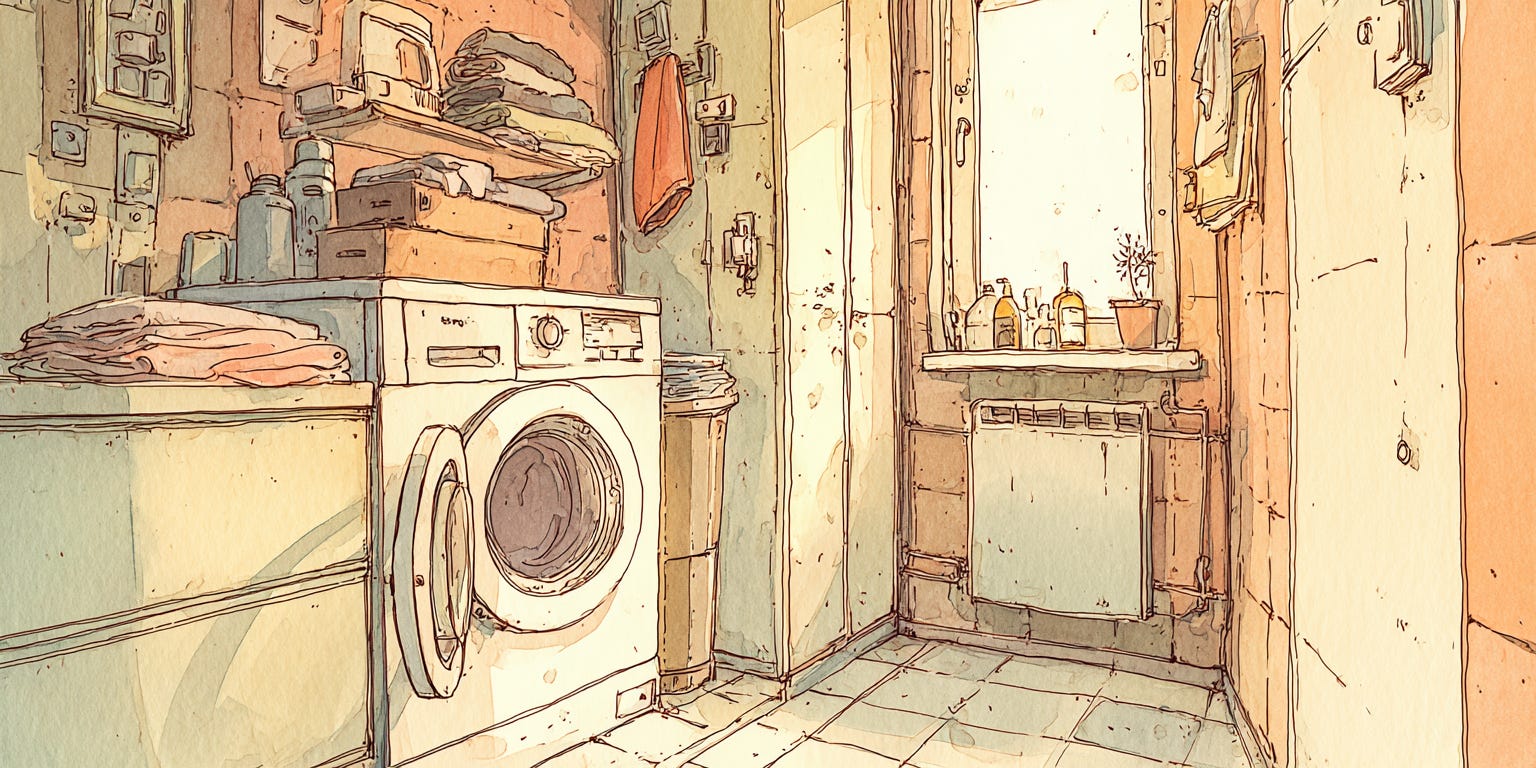
At some point the utility room pile stopped being manageable. I don’t remember exactly when. By the time I noticed, the shame had already set in.
Just not going in unless I had to. Keeping to the corner without the pile. I had developed, without noticing, the skill of not quite seeing a pile of my own laundry.
How does a pile of laundry become something you can’t approach?

The pile doesn’t change. What it says does.
At some point it stops saying do me and starts saying look how long you haven’t done me. It becomes a record. Every day you don’t deal with it, it adds another line to the evidence. By the time it’s large enough to be visible, it’s already testimony against you.
This is the mechanism. ADHD brains carry a higher baseline of shame around task management -- not from lack of trying, but from years of evidence that trying and not finishing is worse than not starting. When a backlog becomes visible, the nervous system reads it as accusatory rather than neutral. A reminder doesn’t help, because it adds to the record. Still not done. Shutdown follows.
The cycle has four stages. Accumulation -- tasks pile slowly, below the threshold of distress. Tipping point -- something shifts: a bad day, a flare, a run of poor sleep. The pile becomes different. Shutdown -- the task turns inaccessible. Not laziness, not avoidance-as-preference; the system has assessed the cost of approaching it as too high. And then shame spiral -- which pre-loads the next cycle before it starts, because now you haven’t done it and you know you couldn’t face it.
The threshold moves. Lower during a flare. Lower on high-pain days. Lower when you’re running on broken nights.
“If the kitchen’s already a mess and then I get a message about three open tasks, I shut down.“ - Jess
That’s the threshold, named from the inside.
The utility room is the dramatic version. The daily version is quieter.
Walking past the sink. The dishes are there - I register them, and something in me responds before I’ve made any decision. A wall. A mountain I’d have to climb, for a sink of dishes. So I walk past.
This is the texture of it. Not a crisis. Just the low hum of things I am routing around.
Then there’s my email inbox. Above about 10 emails and I’ve already written the inbox off - not with shame, but with something more like acceptance.
The inbox though is useful even full. I can search it, find things, use it as an external memory. I can’t see the messages accumulating.
The pile of washing is different. It accumulates with no positive purpose and no reframe. A useful mess stays useful. The pile just sits there.
The threshold between manageable and too much is invisible. There’s no moment where I notice I’m crossing it - no signal, no line. Just a retrospective realisation, at some point, that it’s now a mountain. That I’m now on the wrong side of it. The pile didn’t change. Something shifted, quietly, and I missed it.
That invisible crossing is also where the usual logic of support breaks down.
Below the threshold, a reminder helps. It arrives at the right moment, names the next action, and the system moves. Above it, a reminder adds to the record. Still not done. It doesn’t motivate - it testifies. The pile is already speaking; the reminder joins the chorus. This is why the usual logic fails: the same tool that works when the environment is manageable actively worsens it when the environment isn’t.
The design question, then, isn’t when should I nudge - it’s which side of the threshold is this thing sitting on. That distinction is most of the work. A system that can only send reminders at fixed times is a system that can’t answer this question. It fires regardless of state, which means it will help about half the time and add to the shame the other half.
What scaffolding needs to do is read the environment before it acts. Not it’s Tuesday, this is on the list but how is the environment - and is approaching this going to cost more than it returns. This requires attending to state, not just schedule. It requires knowing the difference between a task that’s waiting and a task that’s become inaccessible.
Getting back, when you’ve crossed the threshold, isn’t a thinking problem. You can understand the cycle completely and still not be able to move. The path back is physical: something changes in the environment, and then you can act again. A good day. Another person in the room. A pile small enough to see the bottom of. You don’t think your way past a threshold state - you change the conditions until the state changes. Scaffolding that understands this doesn’t push harder when something is inaccessible. It waits for a window, and when the window comes, it makes the first action as small as possible.
A very dear friend came over one Thursday morning. Without making a big deal of it, she just folded clean washing with me whilst we chatted.
Less than an hour later, multiple piles folded and put away, weeks of routing around that room were finally undone. Sixty minutes and another body in the room was what it took.
When it was done, the room looked like a room again. One load in the machine. A clear surface. No record - just washing, waiting to be done. The day after, I put a load on. And the day after that.
There will be more days when I avoid the utility. What I know now is what I need in those moments: a Thursday morning with someone else to fold alongside me.
The system isn’t the point. The system exists to create the conditions for a Thursday morning -- to lower the threshold until the first action is possible, and then to stay out of the way.
Sometimes that’s another person. Sometimes it’s a good day arriving unexpectedly. Sometimes it’s scaffolding that read the room right. What it is, always, is enough of a change in the environment that approaching the pile stops costing more than it returns.
One load. Then the surface is clear. Then another.
Coming in this series:
- Energy-adaptive scaffolding - the threshold doesn't sit still. On high-pain days, during a flare, after broken nights, it moves. What changes when the system has to account for that.
- Closing the gap - the same shame cycle, applied to finances. Why the pile of unopened envelopes works exactly like the laundry pile, and what helps.
References
1. Evidence of emotion dysregulation as a core symptom of adult ADHD - systematic review (PMC9821724)
2. Adverse experiences of women with undiagnosed ADHD and the role of diagnosis -- shame, guilt, and negative self-perception in those with late or no diagnosis (PMC12218314)
3. Management of emotional dysregulation in adult ADHD (PMC9568011)
4. Shame, rumination, and procrastination - shame is more strongly associated with avoidance than guilt, and more likely to trigger task delay (PMC9274181)
5. ADHD and procrastination - avoidance as a compensatory strategy when a task feels beyond capacity (PMC6878228)
6. Body doubling for ADHD - task completion faster and sustained attention higher working alongside another person vs alone; VR study, preliminary (arXiv 2509.12153, 2025)